Blog
How Long Does Vyvanse Stay in Your System? 5 Vital Clearance Facts
Introduction
Understanding the pharmacokinetic profile of ADHD medication is essential for patients, especially when navigating workplace drug screenings or clinical monitoring. A frequent concern for many is: how long does vyvanse stay in your system? Whether you are prescribed this medication for Attention Deficit Hyperactivity Disorder (ADHD) or Binge Eating Disorder (BED), knowing the timeline of its activity and eventual elimination is key to informed decision-making.
Vyvanse is unique among stimulants because it is a prodrug, meaning it remains inactive until your body converts it into the active stimulant, dextroamphetamine. This conversion process directly influences how long does vyvanse stay in your system compared to other immediate-release medications. In this guide, we will break down the biological half-life, detection windows for various tests, and the physiological factors that determine how quickly your body clears this substance.
Key Takeaways: Vyvanse Clearance at a Glance
- Metabolic Conversion: The prodrug (lisdexamfetamine) has a half-life of less than 1 hour, but its active metabolite (d-amphetamine) lasts much longer.
- Standard Detection: Most urine tests detect the drug for 2–5 days after the last dose.
- Testing Variations: Blood and saliva tests have the shortest windows (up to 48 hours), while hair tests can detect use for up to 90 days.
- pH Influence: Urinary pH is one of the most powerful factors in accelerating or delaying clearance.
What Is Vyvanse?
Vyvanse (lisdexamfetamine dimesylate) is a central nervous system stimulant. Unlike its counterparts that contain active amphetamine salts, Vyvanse is chemically engineered to be inactive upon ingestion. It only becomes active once enzymes in your red blood cells cleave away the amino acid l-lysine, releasing the therapeutic dextroamphetamine into your bloodstream.
This “slow-release” mechanism is why the medication is categorized within ADHD Medications as a long-acting treatment. It provides a steady therapeutic effect for up to 14 hours, reducing the “ups and downs” often associated with shorter-acting stimulants. This controlled release also plays a significant role in determining how long does vyvanse stay in your system as the body must consistently convert and then eliminate the active metabolites.
Conditions It Treats (Causes & Symptoms)
Vyvanse is primarily indicated for conditions involving dopamine and norepinephrine dysregulation:
- ADHD (Children & Adults): Addressing symptoms like chronic inattention, hyperactivity, and impulsivity.
- Binge Eating Disorder (BED): Specifically approved for moderate-to-severe BED in adults to reduce the number of binge days.
- Executive Dysfunction: Improving the brain’s ability to plan, focus, and multitask.
- Narcolepsy: Occasionally used off-label by clinicians to manage excessive daytime sleepiness.
How Long Does Vyvanse Stay in Your System
To accurately answer how long does vyvanse stay in your system, we must distinguish between the parent drug (lisdexamfetamine) and its metabolite (d-amphetamine). The parent drug disappears almost instantly, typically within 1 hour. However, the active metabolite is what clinicians and drug tests actually track. For most healthy adults, the vyvanse half-life in adults for the active metabolite is approximately 10 to 13 hours.
Clinically, it takes about five half-lives for a substance to be considered “fully” cleared. Based on a 12-hour average, this means you can expect the drug to be largely gone from your plasma within 60 hours, or roughly 2.5 to 3 days. However, when people ask how long does vyvanse stay in your system, they are often referring to “detectability” in a screening, which can persist long after the therapeutic effects have faded.
How Long Vyvanse Stay in Your System Based on Test Type
The detection window varies significantly depending on the biological sample being tested. If you are wondering how long does vyvanse stay in your system for a specific screening, refer to the general timelines below:
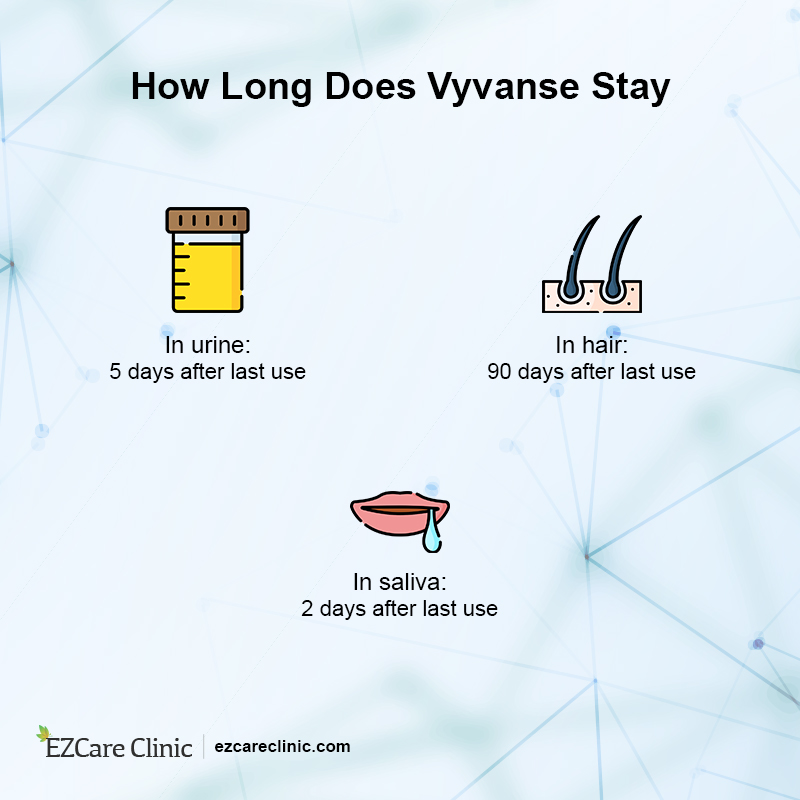
- Urine Testing: This is the most common method. A vyvanse urine test 4 days later may still return a positive result, as metabolites are detectable for 2 to 5 days.
- Blood Testing: This has a much shorter vyvanse blood test window, typically detecting the drug for only 8 to 24 hours after ingestion.
- Saliva Testing: Similar to blood, how long does vyvanse stay in saliva is relatively short, usually around 24 to 48 hours.
- Hair Testing: This provides the longest historical record. The vyvanse hair follicle test window can detect use for up to 90 days.
| Test Method | Detection Window |
| Blood | 8–24 Hours |
| Saliva | 24–48 Hours |
| Urine | 2–5 Days |
| Hair | Up to 90 Days |
Factors That Influence How Long Does Vyvanse Stay in Your System Variation
Several biological and environmental factors that affect vyvanse metabolism can shift the timeline of clearance:
- Urinary pH: This is perhaps the most significant factor. Acidic urine (low pH) accelerates excretion, while alkaline urine (high pH) slows it down, keeping the drug in your system longer.
- Dosage: Naturally, a vyvanse 70mg detection time will be longer than that of a 30mg dose because there is more metabolite for the body to process.
- Frequency of Use: Chronic users may experience accumulation in the tissues, extending the window of how long until vyvanse is fully out of system.
- Metabolic Rate: Individual basal metabolic rates, often influenced by age and genetics, determine how fast enzymes convert and clear the drug.
- Organ Function: Since 96% of the drug is excreted through the kidneys, any renal impairment will significantly prolong the time it stays in your system.
5 Benefits of Understanding Vyvanse Clearance
- Informed Testing: Knowing if a vyvanse urine test 4 days later is a risk helps you prepare documentation for your employer.
- Dosage Management: Understanding how long does vyvanse 30mg last helps you time your morning dose to avoid insomnia.
- Medication Safety: Helps prevent dangerous interactions by knowing when the drug has cleared before starting a new prescription.
- Withdrawal Preparation: Understanding the vyvanse withdrawal timeline after one dose (usually 24–48 hours) helps you manage “crashes.”
- Optimized Performance: Knowing the peak window (3.5–4.5 hours) allows you to schedule your most demanding tasks during maximum efficacy.
Comparison: Single Dose vs. Chronic Use
The question of how long does vyvanse stay in your system changes based on your history with the medication.
- Single Dose: For someone taking it once, the body typically achieves clearing stimulants from your system within 2.5 days.
- Chronic Daily Use: For those on a daily regimen, steady-state concentrations are reached. This means the body is always processing a certain level, and it may take slightly longer (up to 5 or 6 days) to reach a “zero” level in urine.
Safety & General Usage Information
When discussing how long does vyvanse stay in your system, it is important to address common myths. For example, many ask can water flush out vyvanse? While staying hydrated is essential for kidney function, excessive water consumption will not significantly speed up the metabolic half-life. In fact, attempting to “flush” your system can lead to a “diluted” result on a drug test, which is often treated as a “fail” or requires an immediate retest.
Furthermore, it is a clinical fact that does vyvanse show up as amphetamine on a drug test. Standard 5-panel and 10-panel drug screens look for the amphetamine molecule. Since Vyvanse converts into d-amphetamine, it will trigger a positive result. Always ensure you have your prescription documentation ready when undergoing a vyvanse drug test detection window assessment.
Possible Side Effects
While the drug is in your system, you may experience:
- Insomnia: Common if taken late in the day.
- Decreased Appetite: A primary side effect during the active window.
- Dry Mouth: Often persisting until the drug is mostly cleared.
- Increased Heart Rate: A sign of active stimulant effect.
Who Should Avoid It
Vyvanse is contraindicated for individuals with:
- Severe Renal Impairment: Which significantly alters how long does vyvanse stay in your system.
- Cardiovascular Disease: Including hypertension and arrhythmias.
- History of Substance Use Disorder: Due to the potential for misuse.
- Glaucoma: As stimulants can increase intraocular pressure.
Summary: How Long Does Vyvanse Stay in Your System?
In summary, the answer to how long does vyvanse stay in your system is multifaceted. For most adults, the active therapeutic effects last 10 to 14 hours, but the chemical traces remain much longer. While the vyvanse half-life in adults suggests a 3-day window for plasma clearance, a vyvanse urine test 4 days later could still be positive depending on your metabolism and urine pH.
Understanding how long does vyvanse stay in your system is not just about passing a test; it is about understanding your body’s relationship with your medication. From the vyvanse 70mg detection time to the influence of your diet on urinary pH, every factor counts. By respecting the how long does vyvanse stay in your system timeline, you can ensure your ADHD treatment is both safe and effective. Ultimately, knowing how long does vyvanse stay in your system empowers you to manage your health with confidence and clarity.
Making Informed Decisions for Your Health
Navigating life with ADHD requires the right tools and the right information. Whether you are managing your daily dosage or preparing for a routine health screening, understanding the science of your medication is the first step toward success. If you are looking for reliable information and access to high-quality healthcare resources, we are here to help. We invite you to explore our Shop to find the products and information you need to support your mental health journey.
FAQ: How Long Does Vyvanse Stay in Your System?
Does vyvanse show up as amphetamine on a drug test?
Yes, does vyvanse show up as amphetamine on a drug test is a common concern. Because it converts to dextroamphetamine, it will trigger a positive for “amphetamines” on standard screening panels.
How long does vyvanse 30mg last?
A typical how long does vyvanse 30mg last window for therapeutic effect is 10 to 14 hours, though individual metabolism can shorten or extend this.
Can water flush out vyvanse?
No, can water flush out vyvanse is a myth. While hydration supports the kidneys, it does not change the metabolic half-life of the drug.
How long until vyvanse is fully out of system?
Most medical experts agree that how long until vyvanse is fully out of system is approximately 2.5 to 3 days for plasma, though it remains in urine for up to 5 days.
What are the main factors that affect vyvanse metabolism?
The primary factors that affect vyvanse metabolism include your age, kidney function, and notably, your urinary pH. Acidic environments speed up the process of clearing stimulants from your system.
Medical Disclaimer
This article is for informational purposes only and does not constitute medical advice. How long does vyvanse stay in your system can vary significantly between individuals. Vyvanse is a Schedule II controlled substance with a high potential for abuse and dependence. Always consult with a licensed healthcare professional before making changes to your medication or if you have concerns about drug testing. In the event of an emergency, contact your local emergency services (911/111) immediately. For further reading on stimulant pharmacology, refer to the FDA or National Institutes of Health.